Resting in Eternity

Artist: Anna Motamarry

Writer: Justin Dubbs

Editor: Michelle Lo

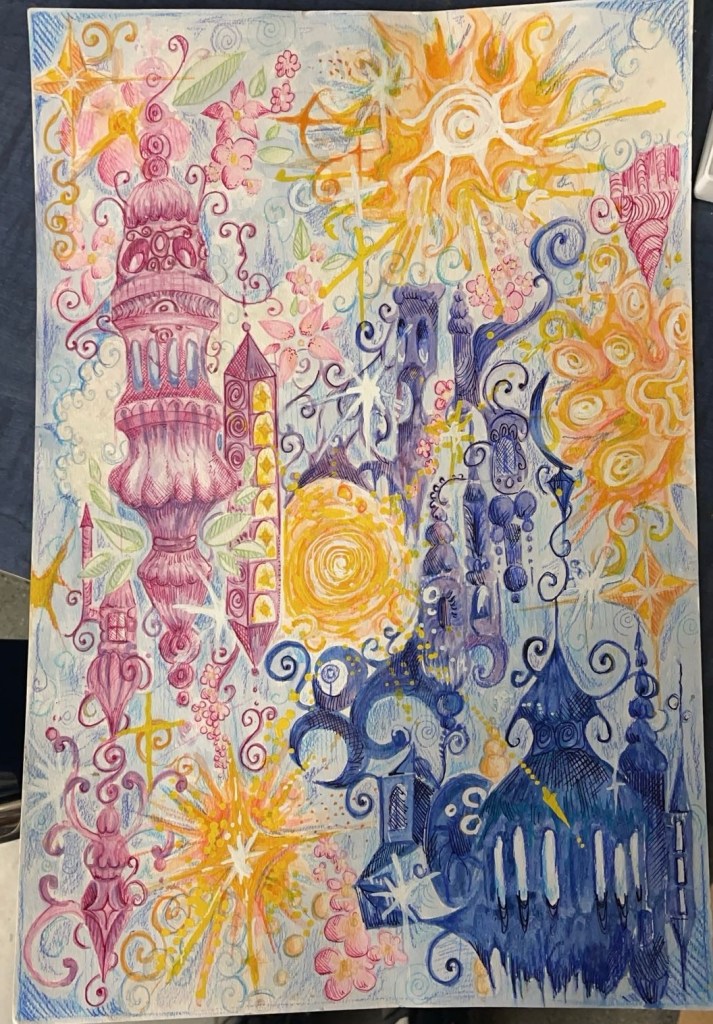
Resting in Eternity is a vibrant and creative capturing of the journey of souls into the afterlife. Although it’s a realm entirely different and unseen from our own, Anna Jaya Motamarry captures the uniqueness and beauty of life after death. A junior at Carlmont High School and just 16 years of age, Motamarry has been creating art for as long as she can remember, nearly 80% of her life, and considers it a personal hobby. She primarily paints in watercolor, this piece being no exception, but she has recently tried other mediums like ink to portray her artistic talents and ideals. Resting in Eternity is but one in a planned collection of imaginative interpretations of the journey a soul takes after it passes from the mortal world with this piece having a theme of unrealistic or visionary interpretation where souls simply rest.
The Magic of Color

Artist: Emi Ota


Writer: Lucas Kishore
Editor: Shiori Chen

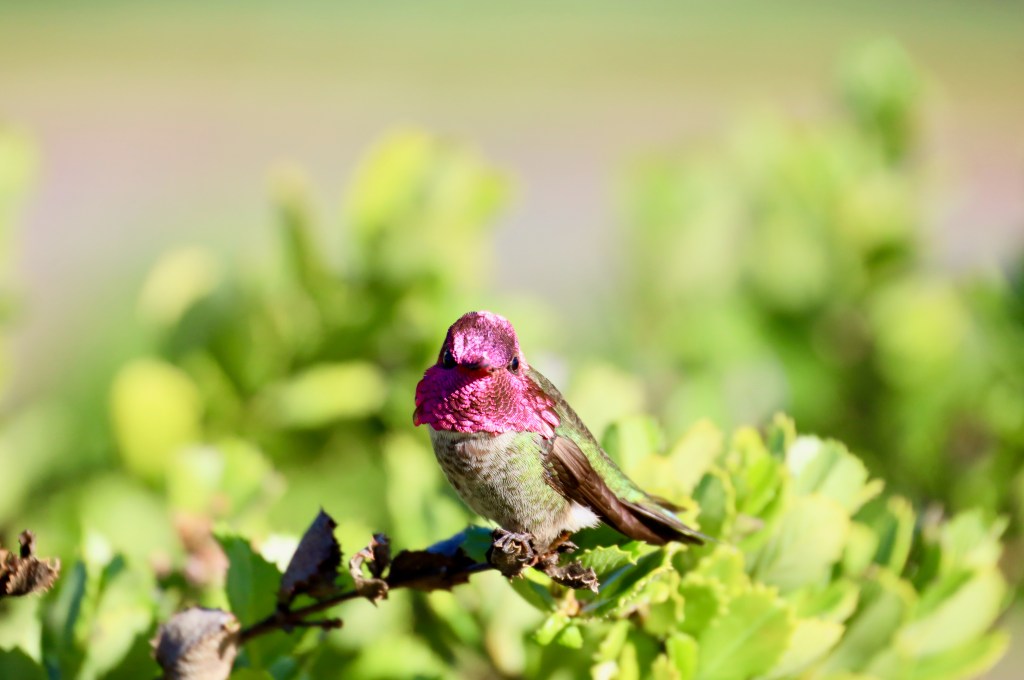
    Emi Ota, a junior at Carlmont High School, has always seen her dad express joy for photography, inspiring her to pick up a camera and start photography as well. Once, during a busy week, she took a break from homework by walking along the local Bay Trail with her camera in hand. Along the way back to her house, she heard the call of a hummingbird, following it to a bush next to her elementary school. To capture a clear photo of a hummingbird, a photographer must get close due to the bird’s miniature size. However, this can be difficult, as shy creatures like hummingbirds tend to fly away, often leaving the photographer with a blurry image of an indistinguishable blob of color. Fortunately, for Emi, this hummingbird didn’t immediately fly away, allowing her to get within range for some close-up photos. While waiting for the right moment, the hummingbird turned its head towards her, and the sunlight struck its face at an angle that lit up its facial feathers in a vibrant pink color that stood out from the green spring leaves. The bird looked completely different, though still the same hummingbird. Through this change in perspective, Emi strives to illustrate that when looking at a particular subject, our perception can change drastically depending on the angle from which we view it, similar to her experience with the hummingbird.

    One Last Goodbye

    Artist: Alaina Yung


    Writer: May Lin
    Editor: Nathan Turnbeaugh

    “One Last Goodbye” is an experimental digital piece by Alaina Yung, representing the brass-bound love of a Ephora, the girl, Sylis, the boy, as the world crumbles around them. 

    As for her background, Yung has had a passion for art as long as she could remember, but her interest in digital art sparked in middle school, right when the pandemic started. During quarantine, out of boredom and a scorching creative desire, Yung experimented with digital art on ibisPaint, gradually moving to a more advanced program, Procreate.

     “One Last Goodbye” took Yung almost three hours to complete, but she is completely satisfied with how the piece turned out. 

    However, beneath the surface, the story of Fung’s piece runs deeper than art. Yung extends her artistry through creative writing, and in fact, “One Last Goodbye” is based on a novel Yung wrote, where at the end of the book, Ephora decides to let the world end in order to die with her lover. The spider lilies in the background of the piece are a symbol of death, being known as the death flower. 

    Overall, Yung is proud of how this piece turned out–experimenting with her art styles and embodying her artistry through various mediums. 

    Starman – David Bowie

    Artist: Lily Stutzin


    Writer: Justin Dubbs
    Editor: Michelle Lo

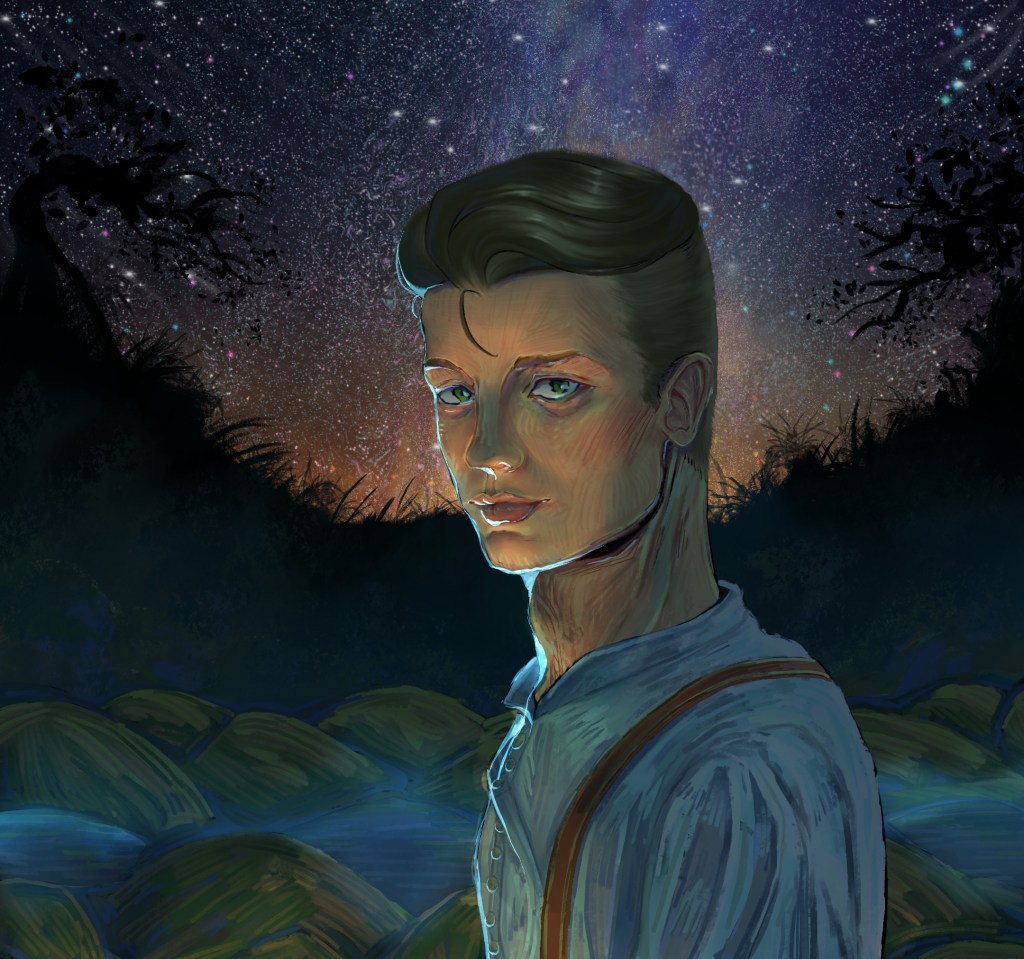
    Lily Stutzin, a junior at Carlmont High School, has been creating art since the COVID-19 pandemic. Purposed initially as a school project, Starman depicts an ideal man as a bust with a vibrant night sky in the background, digitally crafted with several techniques and primarily line-by-line coloring. The piece evokes emotions through the character’s solemn face and the eerie glow of the river, alluding to ancient Greek legends of the river Styx, meant to symbolize the character’s death. The piece is based on the artists and era known as the “Lost Generation,” though primarily on the works of Willy Jaeckel and Pablo Picasso, which used their negative feelings towards WWI and its conclusion to influence their art. They often created unrealistic and seemingly unfinished pieces, as seen in this piece with the individual strokes that form the individual, giving him a more unfinished appearance, with the contrast of the seemingly photographed night sky. The piece symbolizes the end of a life, with the character’s fate left unfinished and leaving only the emotions as remnants, perfectly encapsulating the experience of the “Lost Generation” and the life that could have been. 

    Purple Hues

    Artist: Erick Cheng


    Writer: Giselle Lo
    Editor: May Lin

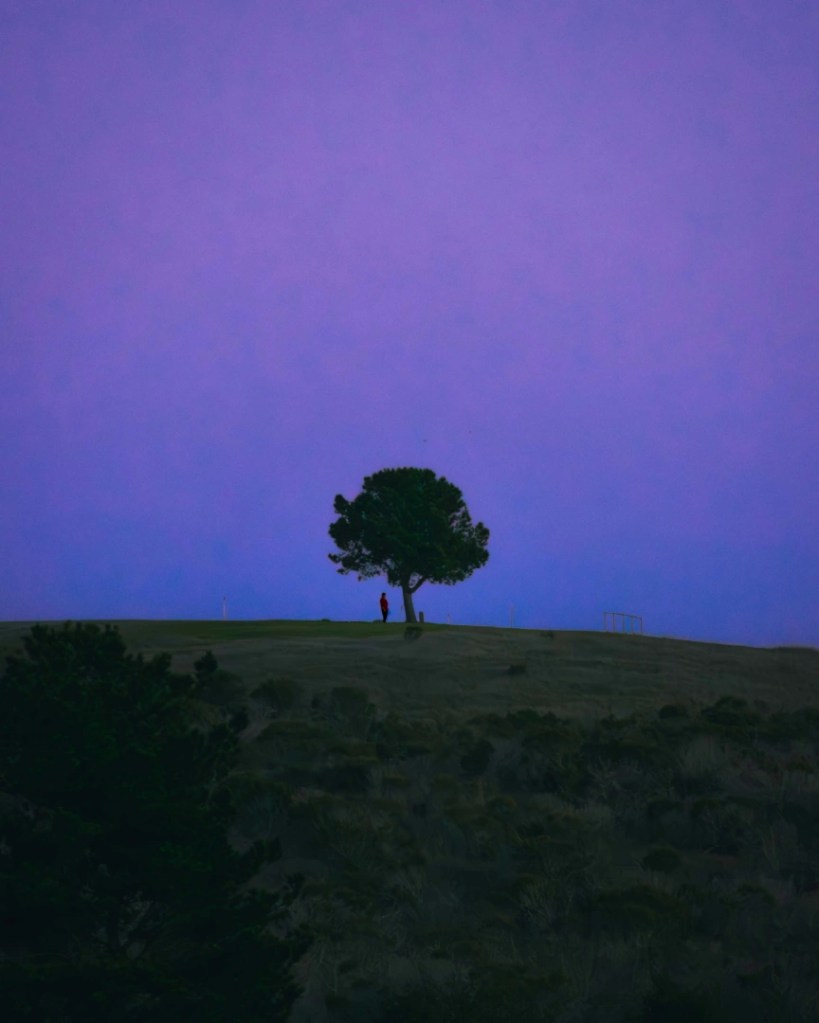
    Purple Hues is a photograph taken by junior Erick Cheng, which represents the overarching theme of self-acceptance. The inspiration for this photograph came when Cheng was outside at night. He found beauty in a person standing alone under a tree. The person was relaxed and enjoying the environment around him without the need to do anything. The purple sky behind the subject provided a peaceful mood for the isolated figures. It made Cheng think about the importance of finding comfort in your own presence. 

    Cheng finds the medium of photography interesting because of its ability to freeze a moment in time. When photos are not too heavily edited, it develops authenticity in the captured moment, which is why he does not put too much weight on editing in his process. 

    “You can always look back on it and see how special that moment was,” Cheng says. 

    Too Little Time


    Artist: Marlena Reinshagen

    Writer: May Lee

    Editor: Nathan Turnbeaugh

    Too Little Time, by Marlena Reinshagan, is an abstract digital art piece that personifies the overwhelming experience of time’s relentless passage.
    Reinshagan embarked on her artistic chapter at a young age, honing her skills as early as fourth grade through extensive practice and artistic studies. While she is primarily a traditional pen and paper artist, her passion for digital art blossomed a few years ago when her parents gifted her a tablet and an Apple Pencil—the ideal materials for the birth of a digital creator. Her involvement in Carlmont’s journalism program further fueled her interest in digital media, as she uses extensive graphics in her news articles.
    As for this specific piece, Too Little Time took Reinshagan 1.5 hours to complete. She meticulously crafted each clock using various Procreate brushes, which proved to be a time-consuming endeavor. One of the major challenges she faced was balancing the contrast between light and dark colors. Originally, she envisioned a bright focal point against a dark background, but achieving the right contrast while maintaining vibrancy was more difficult than anticipated.
    For Reinshagan, this artwork reflects her own experiences with the passage of time and how her perspective of herself fluctuates over time. For her and many others, time can feel like an out-of-control entity. Overall, Too Little Time captures the essence of how people become increasingly conscious of time as they age. It is a poignant reminder of how time is a precious commodity that accounts for the many metamorphoses of life.

    The Time Keeper

    Artist: Annaliese Helweg


    Writer: Everett Keninger

    Editor: Shiori Chen

    The Time Keeper by Annaliese Helweg is a digital art piece that combines a variety of magical and celestial motifs, with the overriding concept of time. The main image is a god-like creature encircled by wings, horns, clocks, and moon phases. These components allude to the passage of time and mysticism. The central figure, whose eyes flash a golden color, seems to float, while one hand fills an hourglass with sand and the other pours liquid metal into a mold shaped like an hourglass. Helweg’s artwork also depicts burning candles with Arabic or Roman numerals on them, alongside two clocks that show each system and how they both tell the same time, despite being read in different units. As the centerpiece of the artwork, the central figure plays a large role in the symbolism of the piece, as their connection to the universe is shown through the lunar cycle in the background. The contrast between the warmer tones produced by the candles and the cooler tones produced by the wings and dark background create a mood of quiet introspection. Additionally, the artwork alludes to time being both a construct and a mysterious force, protected by the Time Keeper. Helweg’s artwork The Time Keeper explores the supernatural and unknown forces of time that rule life and death.

    Mona Lisa Side Eye

    Artist: Kayden Bhatnagar


    Writer: Lucas Kishore

    Editor: Michelle Lo

    Kayden Bhatnagar, a sophomore with no experience in art, decided to spend his summer in a unique way: Drawing on Apple Notes using his phone, a hobby that he intends to continue throughout high school. Spurred on by a funny idea that he got whilst talking to a friend on FaceTime, Kayden was suddenly inspired to draw his take on the famous Mona Lisa by Leonardo da Vinci. While the Mona Lisa painting by Leonardo da Vinci utilized thin layers of oil glazes at different times, Bhatnagar’s artwork requires a slightly different approach. Bhatnagar used the large range of opacities on the brush tool within the app which allowed him to layer and blend colors on top of each other. Despite the original artist’s four-year-long work on the Mona Lisa, Bhatnagar’s work only took approximately three to four hours—a large amount of time was required for both nonetheless. His creative twist, on the Mona Lisa, aptly called the Mona Lisa Side Eye offers the viewer a different outlook on the famous piece. His piece is sure to leave a lasting impression on the viewer and leaves them wondering about the vast expanse of different mediums that can be utilized for creative expression.

    Namiko

    Artist: Shiori Chen


    Writer: Keira Sarmiento
    Editor: Nathan Turnbeaugh

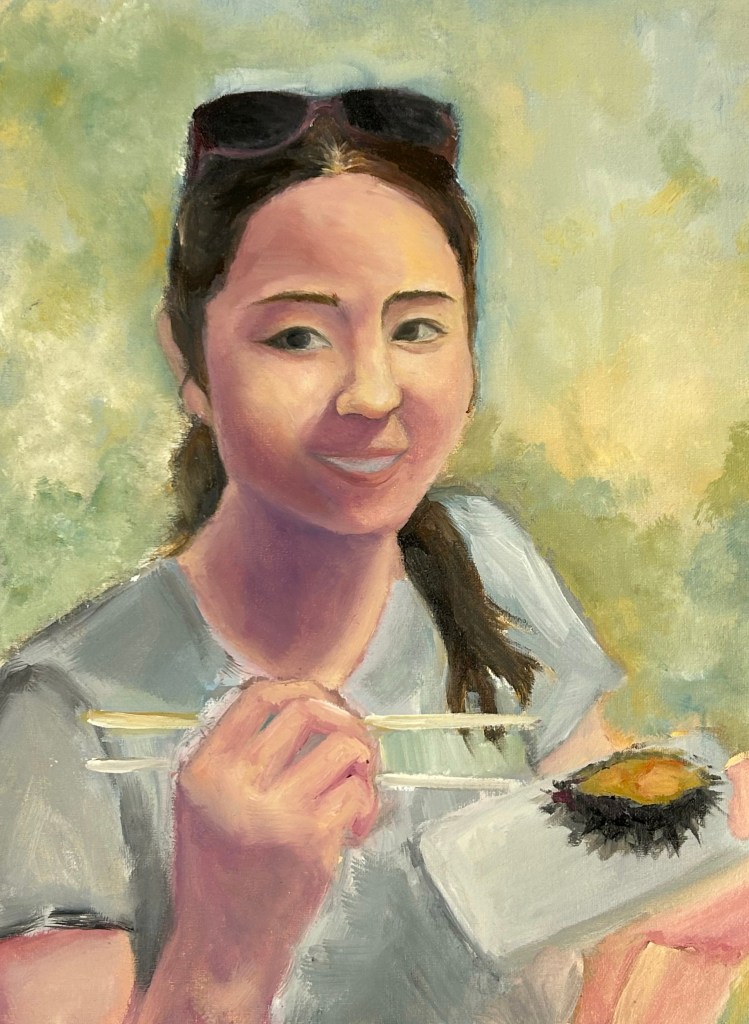
    When 16-year-old junior Shiori Chen was carrying her new oil painting around campus, many classmates saw the portrait of a young woman as she passed by. They’d ask Chen, “Is that a painting of you?”

    “I always thought that was the biggest compliment when people said I looked like my mom because I looked up to her so much,” Chen said. Her mother, Namiko, is the piece’s subject, and the first person Chen thinks of when asked who her “personal hero” is. The reference photo for the painting was from when Namiko was younger, which Chen said she chose because “she looked so happy and genuine” in the picture. In the painting, Namiko grins while holding chopsticks and a plate of uni, or Japanese sea urchin. This represents her mother’s career as a Japanese food blogger as well as her foodie side. “My family and her, part of our values is our love for food,” Chen said. 

    When Chen went through the process of creating the piece, she was excited because she hadn’t had a chance to work with oil paints since she was in seventh grade watching Bob Ross tutorials. “It was really good getting back into that medium because I think it has a very polished look afterward,” Chen said. When she was deciding on the background, she decided against the one in the reference image because it didn’t match her mom’s uplifting personality. Instead, she opted for a light spring green. “That’s the message I wanted to convey about my mother,” Chen said.

    Ukraine

    Artist: Lily Stutzin


    Writer: Giselle Lo
    Editor: May Lin

    Ukraine is a digital art piece that junior Lily Stutzin developed as a project for history. She aimed to show the consequences of the ongoing war between Ukraine and Russia. While making it, she struggled to find something to represent the war’s impact but ultimately decided to sketch a statue. Seeing that statues are a display of someone’s legacy, it was a good fit to depict the consequences war leaves behind. The statue with a hole in its chest and its hands torn off symbolizes the losses brought by the war. 

    Stutzin used the digital art app Procreate to create Ukraine in two hours. She began her interest in art during the COVID-19 pandemic and has continued drawing since then.