Funsies at the Water Temple

Artist: Erick Cheng


Writer: Ellen Li
Editor: Michelle Lo

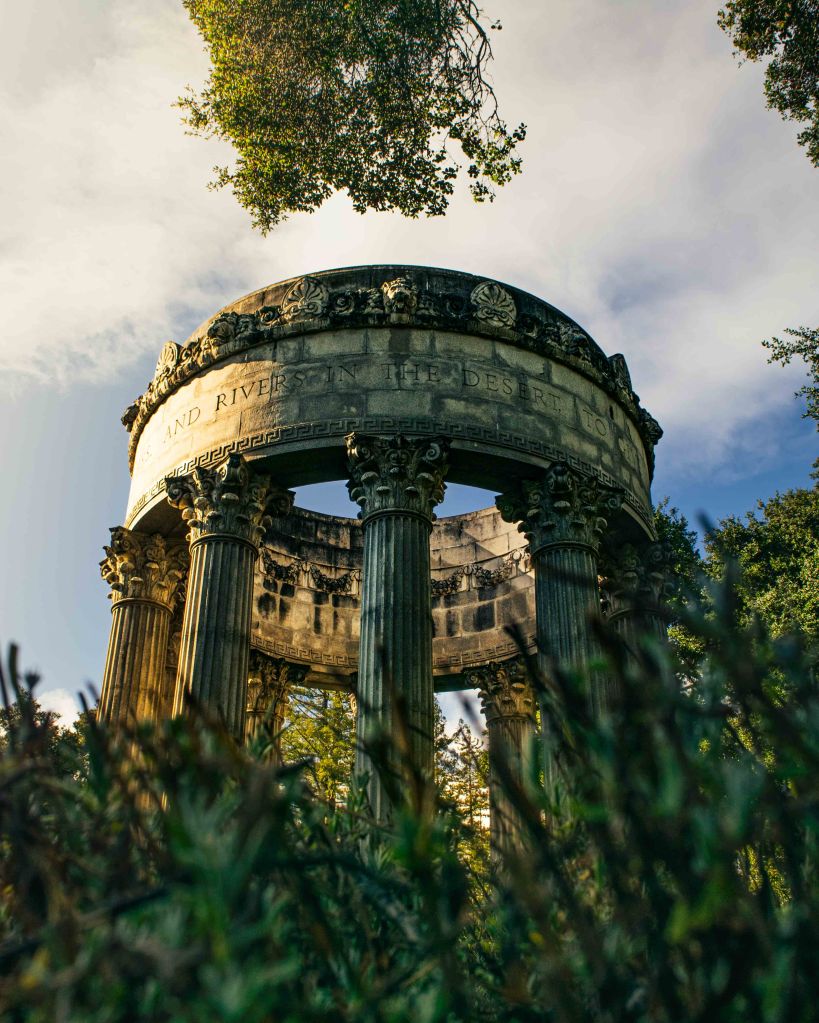
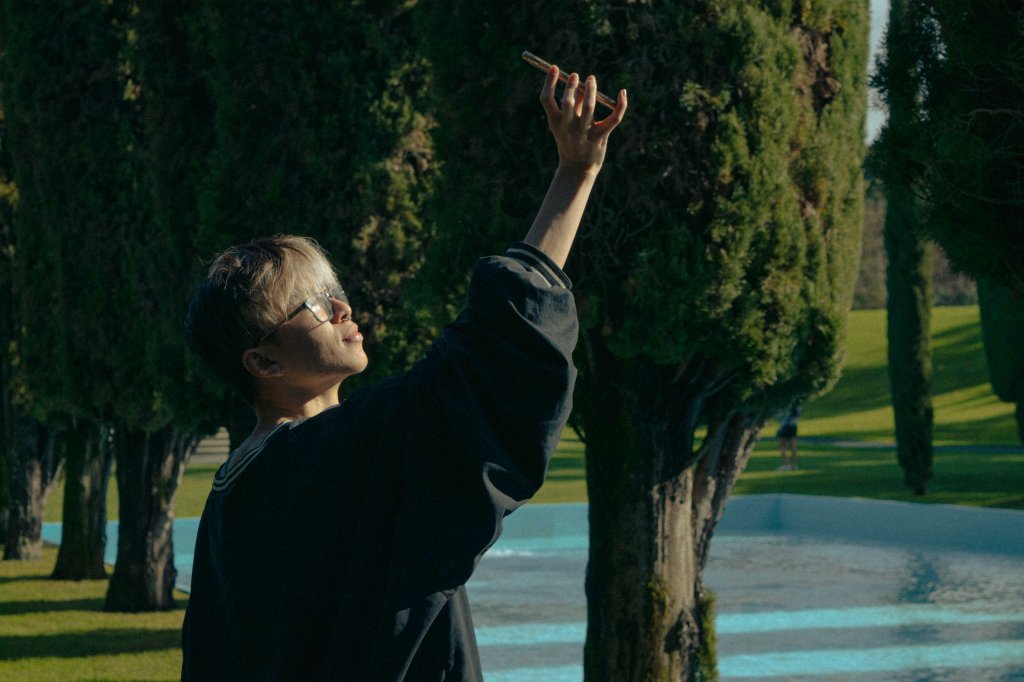
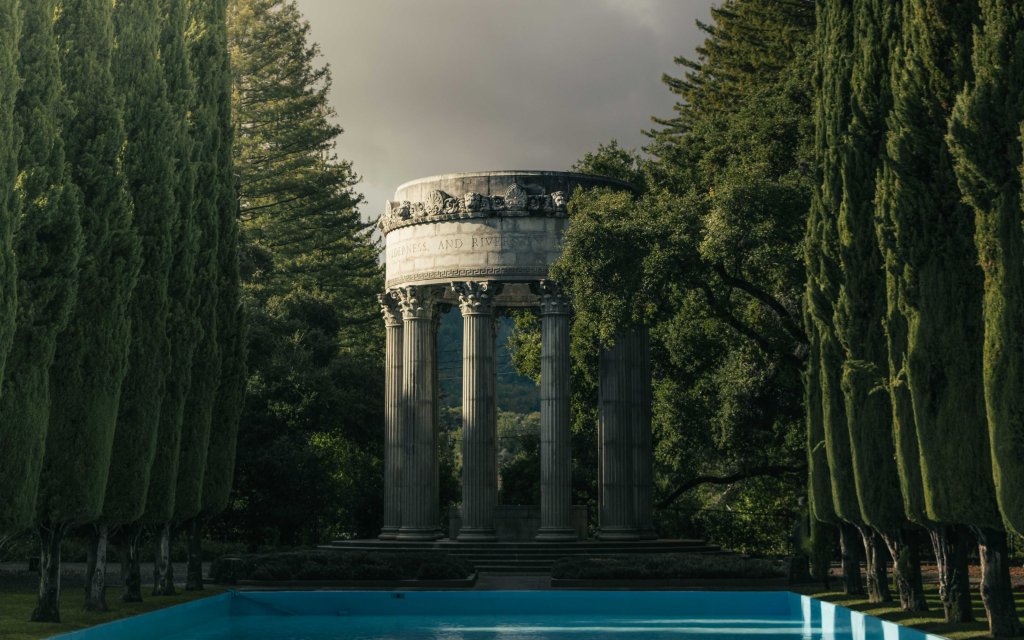
A Carlmont High School sophomore, Erick Cheng, has been a serious photographer for almost a year. He finds photography entertaining—taking new pictures every other week to keep his skills sharp. For his collection Funsies at the Water Temple, he took photos that revealed a water temple’s beauty while trying to accentuate its majestic allure. He edited them using Adobe Lightroom Classic to enhance their natural charm. It took him an hour in total to be satisfied with the visuals.

Cheng believes that photography is an easy art to get into, unlike other arts like drawing or painting, which are more technically demanding. Anyone can go outside and take some pictures while having fun at the same time. He hopes that sharing his photos with the world will entice others to use their imaginations to envision the art they can create. 

Medley

Artist: Sophia Shen-yip
Writer: Justin Dubbs
Editor: Shiori Chen

Sophia Shen-Yip is a 15-year-old sophomore who started her photography pastime in late 2021 amid the pandemic. Her methods are simple as she owns no fancy expensive cameras, but she utilizes programs like Lightroom to present pieces in their best lighting and color. For this particular piece, she spent around 30 minutes editing what might’ve been just a quick snapshot into the most outstanding image of itself. “Medley” is a couple of paper lanterns in a cluttered Chinatown store in San Francisco. While it may not have any significant symbolic value, the picture has a home-like warm tone, conveying calmness and contentment. The lanterns have significant cultural value to the people who hang them up as they are likely used to celebrate the Chinese New Year, an important event in Chinese culture. “Medley” is an image that captures a portion of this culture in a very enlightening and straightforward way, allowing everyone to appreciate this spectacular event. 

Xandra

Artist: Alaina Yung
Writer: Erick Cheng
Editor: Shiori Chen

Alaina Yung, a Carlmont High School sophomore, has previously made beautiful art pieces for Art Showcase Club with her piece, titled Xandra, being no exception. Yung created Xandra based off of her original literary works and pieces of other artists she admires. 

“The inspiration for this piece was of Xandra, a character from an old novel I wrote,” Yung said. “I referenced the hair colors of this piece from an artist called blue biscuits. I think their color theory is very strong and unique.”

To make this artwork, Yung used digital art, applying her knowledge of color theory and hair shading within the program. While this piece was originally intended to be used as a work to practice shading and rendering on, Yung happened to like the finished product. 

“The piece turned out really good so I decided to submit it to the Art Showcase Club,” Yung said.

Moving forward, Yung will continue to make artwork for Art Showcase Club, but also more importantly, for her own enjoyment as well. One thing she advises artists to do is to learn from others, whether that be trying to incorporate elements from other’s work into your own, or to constantly explore the many different types of works within the art community. 

Belonging

Artist: Natalie Su
Writer: Jonathon Park
Editor: Nathan Turnbeaugh

In her new piece, “Belonging,” Natalie Su conveys the nuanced feelings of togetherness and connection through two watercolor birds. As a January Monthly submission, Su’s work addresses the topic of new beginnings by restating the importance of friendships and belonging as the new year arrives, whether it be maintaining old friendships or igniting new ones.

To create “Belonging,” which was completed in an hour and a half, Su began with a pencil sketch, followed by an outline in pen, and then watercolor. From the colors to the shading, every element was especially selected to reinforce the value of belonging. For instance, Su juxtaposes green, her favorite color and thus a representation of herself, with warm colors, which naturally represent warm feelings. In this way, Su portrays her own feelings of belonging through the two birds, yet simultaneously allows the spectator to also experience these same feelings of joy and connection. That is the true genius of this work: the viewer instantly appreciates the connection held between the two birds, for nothing is more valuable than a true friendship.

Su also notes that the connection between the two birds extends beyond simply the physical, with each bird sharing artistic elements from the other, stating “I also wanted to convey ‘belonging’ by adding elements of each bird in the other. I added a green tint in the warm bird’s eye and a warm, purple tint in the green bird’s eye.” Through this artistic and symbolistic technique, Su emphasizes that despite differences in beliefs or background, we can still learn to find commonalities and forge connections with one another, just like these two birds. A green bird and a purple bird may not seem like the two most unlikely friends, but they symbolize how, by putting ourselves out there to discover new people and friends, we can establish our own sense of belonging. 

Rundle

Artist: Natalie Su
Writer: Jiho Park
Editor: Shiori Chen

Rundle, a beautiful landscape painting, was created by Natalie Su, a 17-year-old senior. This painting was crafted from watercolor paints and a pen, which took the artist about an hour to create. The inspiration behind this painting is a photo she took of a mountainscape during her trip to Banff, Canada. This trip would prove to be delightful for Su, and when the Christmas season came around, she would paint this piece because she wanted to capture this particular memorable moment.

Gluttony

Artist: Shiori Chen
Writer: Nathan Turnbeaugh
Editor: Michelle Lo

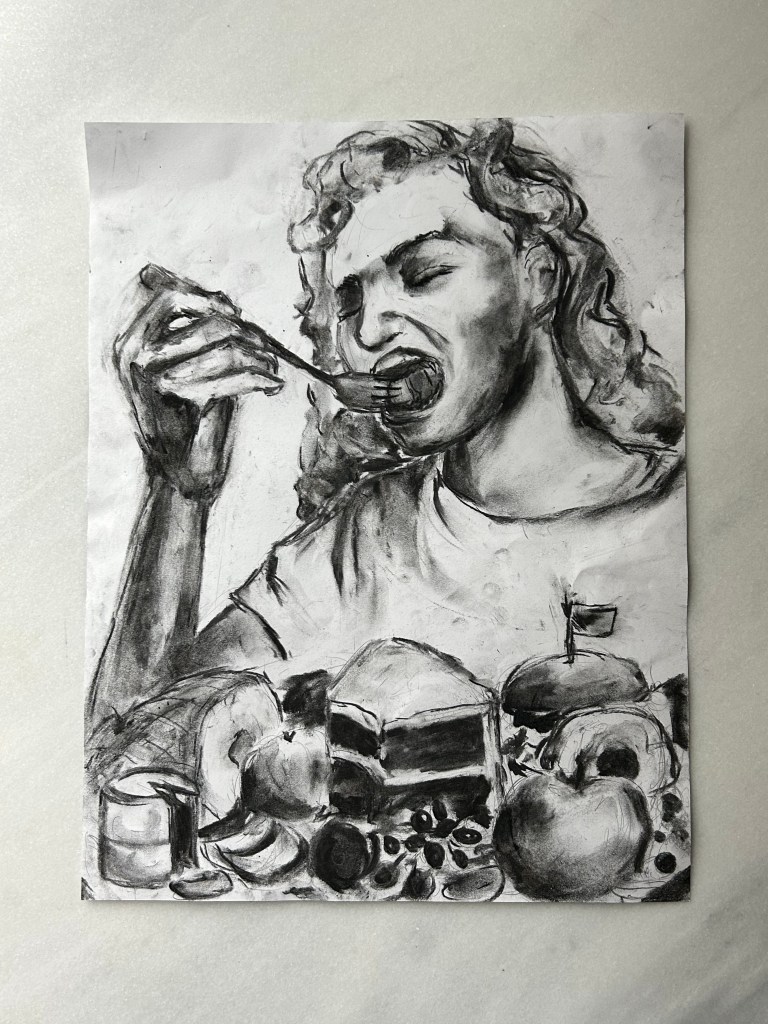
Gluttony, a charcoal piece, was created by Shiori Chen for her Studio Art final, however, the origins and inspiration behind the piece lay much deeper than that of a simple school project. For as long as she could remember, Chen has found herself repulsed by the act of overindulging in food. She has attempted to find the reason behind her disgust, but the issue is far more personal than simply disliking greed, as her entire grasp on people as a concept had been altered by this wrenching disgust. She attempted to capture this guttural feeling within her work, utilizing nearly a decade of experience in various mediums and a special fondness for the charcoal sketch, all while driven on by the prompt she was given for her class’s final, “Ugly.”

All the Words I Couldn’t Say

Michelle Lo

I wish I could say how sorry I was about that day.

The memory so vivid—it feels just like yesterday.

The somber mood drowned the air

As I felt a twinge of heartbreak and despair.

I wish I could remember your last “Hello,”

But all I remember is your smile that haunts me so.

I sat away—afraid of the sickness

That would take you away without forgiveness.

You pat the empty seat next to you

That I reluctantly moved quietly on to.

There’s so much that I wish I could say.

I could have even hugged you instead of pushing you away.

I remember your smile—so bright and kind,

It made me forget your fate that had been assigned.

I hope you know that I was selfish,

And that the guilt that has haunted me has been hellish.

I hope you know I still miss you so

And I hope you know I love you so.

Some day I know we’ll meet again

When my life too will come to an end.

You’ll be waiting with radish cakes—

The dish you know I like more than steaks.

I’ll tell you how sorry I was for my actions that day

And that I missed you more than words can even portray.

I’ll be waiting for that day when I can see your face,

And I can’t wait to meet you again with a warm embrace.


Michelle Lo has long found solace in her words. All the Words I Couldn’t Say is an attempt to unravel her interlaced guilt and pain, woven for years through the very fabric of her being. Reflecting on her trip to Hong Kong to say goodbye to her terminally ill grandmother, she battles with her youthful naivety and the pain it has caused her. Lo’s reluctance to spend time with her grandmother during their last meeting stemmed from her innocent fear that she would “contract” the cancer that had afflicted the body of her loved one. The decision she made in her youth has persisted, evolving into remorse, forcing her to finally confront her unresolved past. 

Lo believes that poetry consolidates her experiences and allows her to remember her memories in fuller detail. “Writing poetry makes everything feel so much more real and allows me to express my pain and emotions in a way that feels powerful,” Lo said. Being able to cope with her experiences in such an honest art form has allowed Lo to remind herself that imperfections are inherent in life and that nothing or no one is flawless. 

Masked Springtide

Artist: Tomoki Urata
Writer: Nikko Sandez
Editor: Michelle Lo

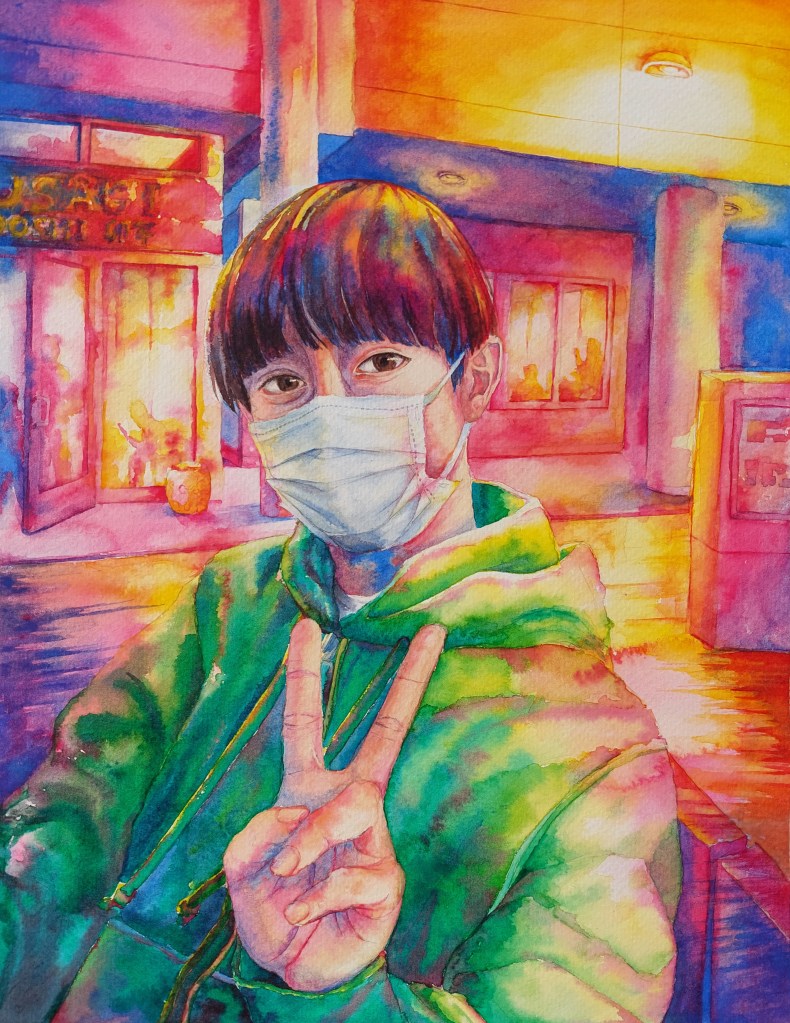
Tomoki Urata, a 17-year-old artist at Carlmont High School, painted this piece called Masked Springtide, inspired by his earlier experiences with art. When he was young he liked Kirby, as he was easy to draw. He liked being able to draw with his friends and come up with combined ideas using their imagination. Urata created Masked Springtide to remind himself what his youth was like if he ever looked back in the future. COVID-19’s lockdown and its eventual monotony played a big part in his youth, so he wants to show others that his experience with COVID-19 was still enjoyable which he conveys by using vibrant colors to add warmth to the painting. Urata wanted to express how he made the most out of his youth even if there were some setbacks, however, there were some things he could not do due to the pandemic.

Tomoki Urata, a 17-year-old artist at Carlmont High School, painted this piece called Masked Springtide, inspired by his earlier experiences with art. When he was young he liked Kirby, as he was easy to draw. He liked being able to draw with his friends and come up with combined ideas using their imagination. Urata created Masked Springtide to remind himself what his youth was like if he ever looked back in the future. COVID-19’s lockdown and its eventual monotony played a big part in his youth, so he wants to show others that his experience with COVID-19 was still enjoyable which he conveys by using vibrant colors to add warmth to the painting. Urata wanted to express how he made the most out of his youth even if there were some setbacks, however, there were some things he could not do due to the pandemic.

Room

Artist: Lily Stutzin
Writer: Aaroha Save
Editor: Michelle Lo

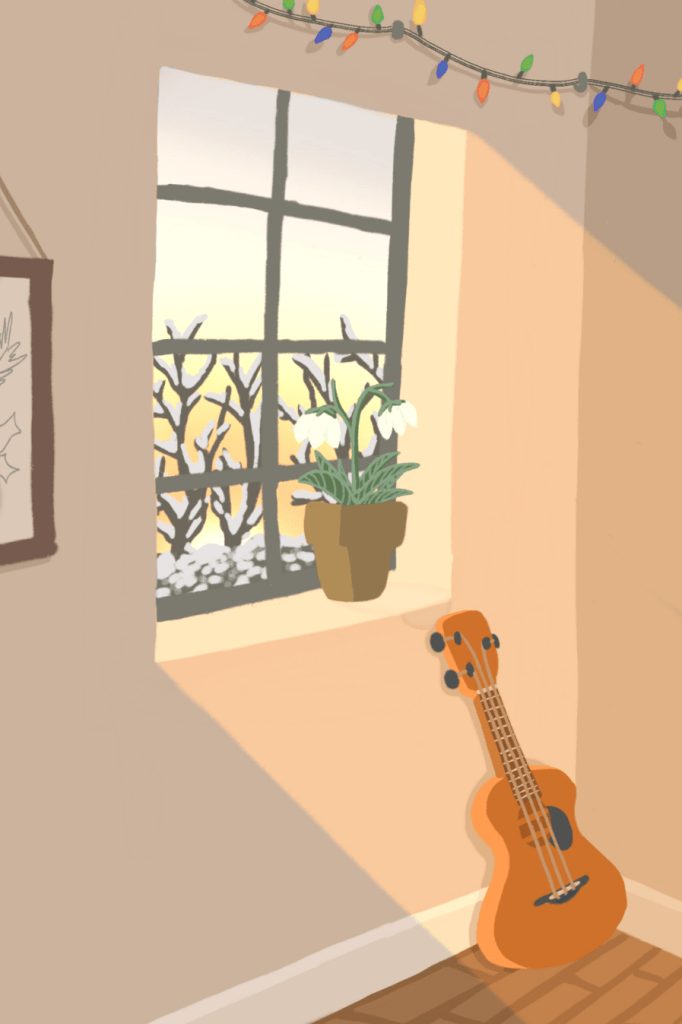
Lily Stutzin, a 15-year-old sophomore at Carlmont High School is the creator of “Room,” a simple yet stunning piece. Inspired by her nostalgia surrounding wintertime rental houses, she sought to create a piece of art that would embody her bittersweet emotions. Lily hopes that people will find a deeper meaning and nuances in her art individually, rather than being given an objective literary analysis. Conveying meaning through art, while extremely difficult, is something that Lily has managed with masterful ease. Overall, “Room” is a thought-provoking piece that also manages to keep its beauty and simplicity.

Carolina

Artist: Natalie Su
Writer: Jonathon Park
Editor: Shiori Chen

Natalie Su’s piece “Carolina” paints a clear image of her love for nature, literature, and life’s other gifts. Natalie Su, a senior at Carlmont High School, has always enjoyed art, which she began experimenting with as a young child. Her interest in art was especially bolstered by the advent of the pandemic, which provided her ample time to look into free art courses and watch videos in order to better her skills. This year, Natalie is taking Studio Art, and she hopes to continue learning about techniques and styles as the class progresses.

Su describes how her piece “Carolina” drew inspiration from the novel and movie “Where the Crawdads Sing,” a fictional piece that features a young protagonist living in the marshes of North Carolina who becomes involved in a puzzling murder investigation. As Su recounts, “I took some elements and symbols that represented Carolina and its swamps… to tie into the theme [of being] thankful for nature and being able to connect with the surrounding environment.” Evidently, the purpose of Su’s artwork “Carolina” is twofold: to show her appreciation for nature and to pay homage to a fulfilling literary piece. Su’s ability to encapsulate this complex theme of life’s gifts into a stunning, nostalgic watercolor with accompanying poetry is no short of incredible, and is precisely why she won Art Showcase Club’s December Monthly.

As Su progresses with her artistic endeavors, she will continue to use art as a means to both destress and explore her creative side. From this, perhaps there is something we too can take into account: the beauty of the little things in life, and the satisfaction that comes with portraying this beauty. Natalie Su’s creations are a testament to the value of life’s little things, the appreciation of which not only provides us respite but can highlight the beauty of even the most mundane subjects.